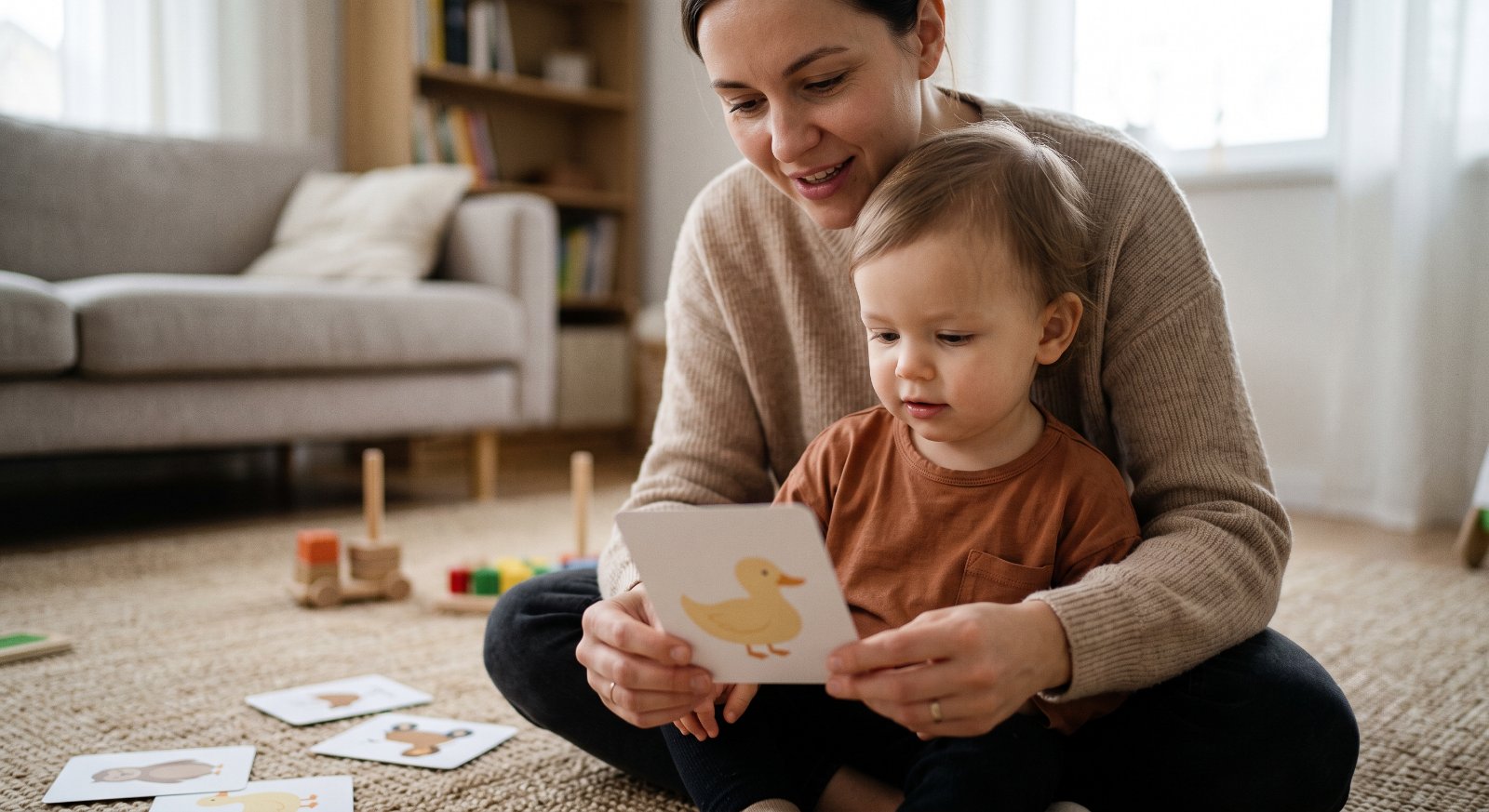
If your toddler isn't talking as much as other children their age, you are in very good company. Estimates suggest a meaningful share of young children experience some delay in speech or language — and for many parents, the first thing they reach for is a set of flashcards.
So do they actually help? The honest answer is: yes, but only if you use them the right way. Here's what that means.
Flashcards aren't magic — connection is
The old picture of flashcards is a parent holding up a card, saying a word, and waiting for the child to repeat it. Drill, response, repeat. For a child who isn't talking yet, that can quickly feel like pressure — and pressure is the enemy of early speech.
What the research and speech-language professionals tend to agree on is that the card isn't what helps. The shared moment around the card is. A flashcard is just a starting point for a tiny conversation between you and your child.
How to use cards without it feeling like a test
- Follow your child's lead. If they linger on the dog card, stay there. Talk about the dog. Make the sound. Let their interest set the pace.
- Narrate, don't quiz. Instead of "What's this? Say it," try "A cow. The cow says moo." You're modelling language, not demanding it.
- Leave space. After you name something, pause. Give your child room to fill the silence — even with a sound, a point, or a look. That's communication too.
- Keep it short. Two minutes of warm attention beats fifteen minutes of a child being asked to perform.
- Celebrate any attempt. An approximation ("ba" for "ball") is a win. Repeat it back correctly and warmly, never as a correction.
Physical cards vs apps — you don't have to choose
Parents often ask whether paper cards or a digital app is better. The truth is they do slightly different jobs.
Physical cards are wonderful for tactile, screen-free moments. Apps can add something paper can't: the spoken word, every time, in a consistent voice — so your child hears the sound clearly even when you're juggling three other things.
The thing to avoid isn't screens. It's passive screens. A cartoon talks at your child. A good flashcard app is meant to be used with you, one card at a time, as a prompt for the two of you to interact.
A note on calm
For children who find the world a bit loud — including many autistic children — the design of a tool matters as much as its content. Flashing animations, surprise sound effects and busy screens can overwhelm a child right when you want them relaxed and receptive.
This is the heart of why we built Pictocards the way we did: no flashing, no surprises, every transition predictable. A card shows a calm illustration, a real photo, and says the word aloud — gently — in Swedish and English. Then it waits. The quiet is the point.
When to seek more support
Flashcards, songs, narration and play are all wonderful at home. But they're not a substitute for professional guidance. If you're worried about your child's speech, talk to your doctor or a speech-language pathologist. Early support is genuinely valuable, and asking for it is a sign of a tuned-in parent, not an anxious one.
Used gently, as a doorway into connection rather than a test, flashcards can be a lovely part of helping your child find their voice — at their own pace, beside someone who loves them.