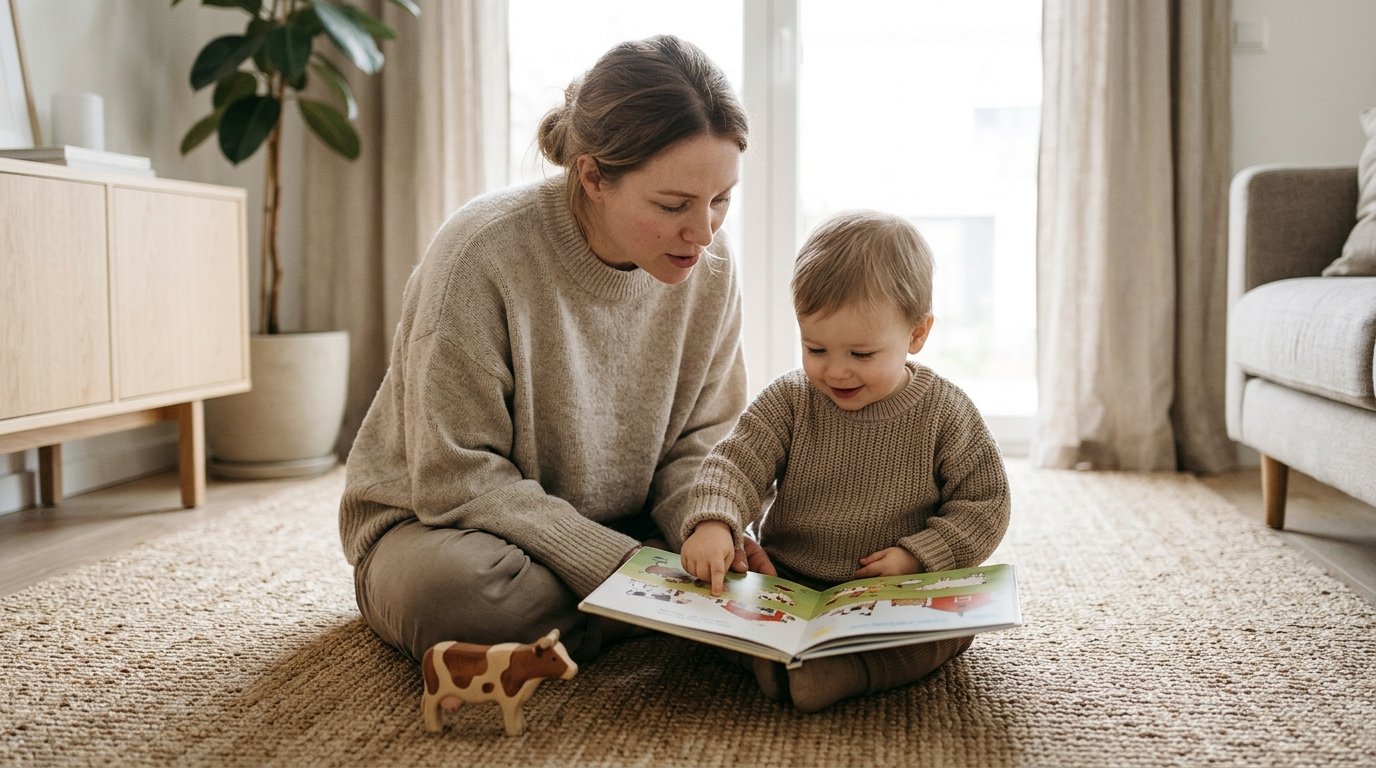
When we look at a picture book together, I read the story, and then I often add to it. I point at what else is happening in the pictures and say it in simpler words. "Oh look, there's a star." "Look, the tractor is plowing the field." The text tells one story, and the pictures usually hold a few more.
How much I add depends on the book. Some stories are simple and leave a lot of room around them. Others have enough going on already, and the best thing is to read them as they are. There's no fixed rule. Being flexible, and following the book, has been the key for me.
What it does is stretch the book. A short story about a farm ends up holding more words than the author wrote. It builds the vocabulary in the book, and the visual vocabulary too: the things in the picture now have names.
There's research on why this works. It also shows what happens to a busy page when nobody points.
Do busy pictures make new words harder to learn?
Zoe Flack and Jessica Horst at the University of Sussex read storybooks to three-year-olds. Some of the children heard stories with one illustration at a time. Others heard the same stories with two illustrations across the open book. The children who saw one picture at a time learned about twice as many new words (Flack and Horst, 2018).
The words were the same and so were the stories. The only difference was how much there was to look at while the word was said.
Then they tried something simpler. When the reader swept a hand toward the right picture while reading, the children who saw two pictures learned the words much better. Once someone showed the child where to look, the extra picture stopped getting in the way.
Why does pointing help?
A child hearing a new word has a puzzle to solve: which of the things in front of me is the "tractor"? Adults solve it in a blink. A toddler is still learning how, and every extra thing in view is one more possible answer. You say "toothbrush", and your child is looking at the duck on the bath mat.
There's an older finding that fits. Michael Tomasello and Michael Farrar watched mothers talking with their toddlers and found that the children learned more words when the parent named what the child was already looking at, compared with when the parent tried to move the child's attention somewhere else (Tomasello and Farrar, 1986).
Put the two together and you get the idea this post rests on: a word is easiest to learn when it arrives at the same place as the child's attention. A busy picture spreads that attention out. Pointing brings it back to one thing, and then the busy picture becomes the best part of the book, because there's so much in it to name.
How to read a picture book with your toddler
You don't need new books or an app for this. A few small habits get more out of the books on your shelf:
- Point as you say it. Touch or sweep toward the thing you're naming. That's the gesture from the study, and it's the easiest change on this list.
- Read past the text. The star in the corner and the tractor behind the farmer are words too. Name them, then say what's happening in the simplest words you can.
- Name what they're looking at. If your child is looking at the duck, say "duck". You can get to the toothbrush later.
- One thing at a time on busy pages. Pick one thing, name it, and let your child find it with you before you move on.
- Cover the other page for a brand new word. If a spread has two pictures and the word is new, rest your hand on the one you aren't talking about.
How we use this in Pictocards
This is the reason Pictocards shows one card at a time, with one picture and one spoken word. It's also why some decks come in more than one look. On the website, Daily Routines comes as a scene and on a clean background, and Feelings comes in three looks. The clean versions have nothing in the frame but the thing being named, and we made them with autistic children in mind.
Children meet words in a lot of different situations. Some days a full scene is what makes a child curious. Other days, or for other children, there's already enough going on, and one clear picture is what lets the word land. We want Pictocards to work in as many of those situations as we can, so the picture fits the child and the moment they're in.
We wrote more about the thinking behind that in why calm by design matters. And if you want the bigger picture of how words come together in the first years, start with how toddlers build their first words. For more small ways to play with words at home, try these calm, playful ways to use flashcards.
Sources
- Flack, Z. M. and Horst, J. S. (2018). Two sides to every story: Children learn words better from one storybook page at a time. Infant and Child Development, 27(1), e2047. Plain-language summary: University of Sussex, via ScienceDaily (30 June 2017).
- Tomasello, M. and Farrar, M. J. (1986). Joint attention and early language. Child Development, 57(6), 1454 to 1463.